close
Choose Your Site
Global
Social Media
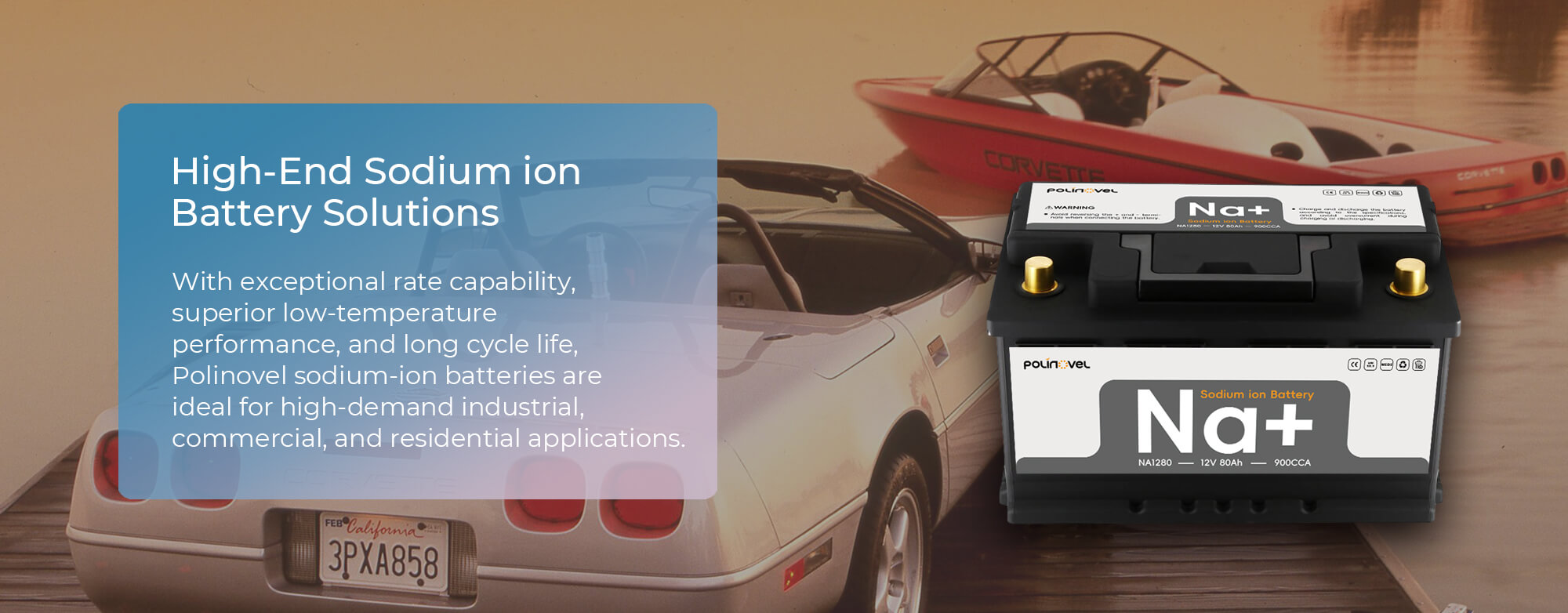
Polinovel NA Series sodium-ion batteries deliver breakthrough innovation that blends cost-efficiency, safety and high performance. Engineered for versatility, our sodium-ion technology seamlessly supports demanding industrial, commercial, and household applications—offering a safer alternative to conventional batteries.
Enhanced Safety
Featuring a non-flammable electrolyte and advanced thermal management, our sodium-ion batteries effectively prevent thermal runaway and ensure reliable, worry-free operation.
Exceptional Low-Temperature Performance
Polinovel sodium-ion batteries perform reliably across a wide temperature range—from -30°C to 65°C. With over 80% capacity retention at -20°C, our batteries are ideally suited for demanding environments and extreme climates.
Cost-Effective Durability
Delivering over 4000 cycles with 80% capacity retention, Polinovel sodium-ion batteries offer decade-long reliability. Their extended lifespan and low maintenance needs significantly reduce life cycle costs, providing long-term savings and exceptional value.
Versatile Applications
With outstanding rate capability and superior performance in low temperatures, Polinovel sodium-ion batteries are the ideal solution for reliable and efficient starting in cars, motorcycles, and marine equipment. Plus, our batteries power a wide range of high-demand applications, including forklifts, golf carts, RVs, industrial backup power for factories, data centers, and telecom towers.
Specification
Model | NA1280 |
Rated Power | 12V 80Ah (Cells: 3.0V 10Ah; Configuration: 4S8P) |
Energy | 960Wh |
Starting Current | 900CCA |
Standard Charge Voltage | 15.6V (Single Cell: 3.9V) |
Discharge Cut-off Voltage | 8V (Single Cell: 2.0V) |
Max. Charge Current | 80A |
Max. Constant Discharge Current | 200A |
Peak Discharge Current | 400A @5s |
Dimension | 314*175*188mm / 12.4*6.9*7.4in |
Weight | 13kg / 28.7lbs |
Cycle Life | ≥2500 (1C@DOD100%); ≥4000 (0.2C@DOD100%) |
Charge Temperature | -20~60ºC |
Discharge Temperature | -30~65ºC |
Storage Temperature | 0~45ºC |
Remarks: The recommended charge voltage for this sodium ion battery is 15.6V. When using a charging system with a voltage between 13V and 14.6V, the battery can be charged to approximately 85% of its capacity. To reach a full 100% charge, upgrading to a 15.6V charging system or using a dedicated 15.6V charger is recommended. | |
Built for applications with higher short-duration cranking demand, this 80Ah model delivers 900 CCA and 400A peak discharge for 5 seconds in a lower-profile 314 × 175 × 188 mm case.
Designed for commercial equipment and diesel engines that require strong short-duration current during startup.
Supports high-current cranking for workboats and marine diesel engines where dependable engine restart is critical.
Provides rapid cranking power for industrial gensets requiring high current during engine ignition and startup.
Suitable for excavators, loaders, tractors, and other engine-driven machinery with demanding cranking requirements.
For engine-starting applications, each battery chemistry offers a different balance of cold-weather performance, cranking capability, service life, weight, and system compatibility.
Feature | Lead-Acid | Lithium-Ion | Sodium-Ion |
|---|---|---|---|
Low-Temperature Performance | Capacity and cranking performance decline noticeably in cold conditions | Performance varies by chemistry; low temperatures can reduce charge and discharge capability | >80% capacity retention at −20°C; discharge down to −30°C |
Starting / Cranking Output | Proven technology for high-current engine starting | High-current output depends on cell chemistry and pack design | 900 CCA with 400A peak discharge @ 5s |
Cycle Life | Typically 300–500 cycles | Typically 3,000–5,000 cycles | Up to 4,000+ cycles under specified conditions |
Weight | Generally the heaviest option | Typically the lightest | Lighter than comparable lead-acid batteries |
Battery Management | Usually no integrated BMS | BMS required | Integrated BMS for protection and cell management |
System Compatibility | Broad compatibility with conventional 12V charging systems | Requires a compatible charging profile | Charging voltage and system compatibility should be checked before replacement |
Which Battery Is Better for Starting Applications?
Lead-acid remains a practical choice where compatibility and upfront cost are the main priorities.
Lithium-ion offers low weight and long cycle life.
Sodium-ion is particularly attractive for applications requiring strong cold-weather cranking, high-current output, and long cycling capability.
For replacement projects, always check CCA, battery dimensions, terminal layout, charging voltage, and operating temperature before selecting a battery.
Choose the right model based on capacity, required CCA, and peak starting current.
Model | Capacity | Starting Current | Peak Discharge | Selection Guide |
50Ah | 600 CCA | 200A @ 5s | Compact option for lower starting-current requirements | |
60Ah | 800 CCA | 200A @ 5s | Higher cranking output with moderate capacity | |
70Ah | 800 CCA | 200A @ 5s | More capacity while maintaining 800 CCA | |
80Ah | 900 CCA | 400A @ 5s | Higher cranking and peak-current demand | |
90Ah | 1000 CCA | 400A @ 5s | Higher starting-current requirement | |
100Ah | 1200 CCA | 400A @ 5s | Highest capacity and cranking output in this range |
When the standard configuration does not fully match your equipment, Polinovel can adapt the battery around the starting demand, installation space, electrical interface, and operating requirements.
CCA, peak current, and battery output can be matched to the engine’s actual starting requirements.
Battery dimensions, mounting layout, and case design can be adapted to different installation spaces.
Terminal position, polarity, connection layout, and charging parameters can be configured to match the existing system.
BMS protection settings, product identification, labeling, and project-specific requirements can be customized for OEM applications.
Share your CCA requirement, battery dimensions, terminal layout, charging voltage, and application details for configuration evaluation.