

close
Choose Your Site
Global
Social Media


Many setups use more than one battery—think solar storage systems, RVs, or storage banks. How you connect them changes the voltage, current, and overall performance.
Wiring them the wrong way can quickly cause trouble: the voltage might not match your equipment, currents can spike, and runtime can drop.
That’s why understanding batteries in series vs parallel matters. Connecting in series raises voltage, while parallel increases capacity. The total energy stays the same, but it’s delivered differently.
We’ll go through both options and show you which one suits your system.
What’s the Difference Between Batteries in Series and Parallel?
How you connect your batteries makes a real difference in how your system runs. That’s why it’s important to understand series and parallel wiring.
Here is a simple comparison table:
| Feature / Aspect | Series Connection | Parallel Connection |
| Voltage | Increases (sum of all batteries) – powers high-voltage systems | Stays the same – keeps system voltage stable |
| Capacity (Ah) | Remains the same – total energy unchanged | Increases (sum of all batteries) – longer runtime |
| Current | Same through each battery – less system current overall | Shared among batteries – higher total current draw |
| Runtime | Limited by single battery capacity | Extended – more energy stored |
| Best Use Cases | Electric vehicles, forklifts, industrial equipment | RVs, boats, backup power systems |
| Risks / Watch | Mismatched batteries → imbalance, faster wear, overheating | Weak or old batteries → uneven discharge, reduced lifespan |
Quick Tips:
Series → raises voltage for high-power devices, reduces system current, and uses thinner wires.
Parallel → increases capacity for longer runtime, higher current, thicker wires.
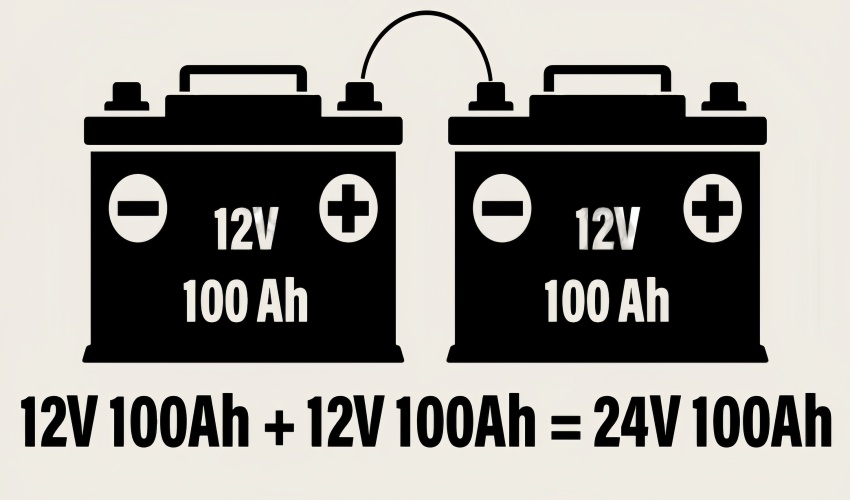
In a series connection, battery voltages are combined while the amp-hour rating remains unchanged. This approach is often used in industrial inverters that need higher operating voltage.
Here’s how you can connect your batteries:
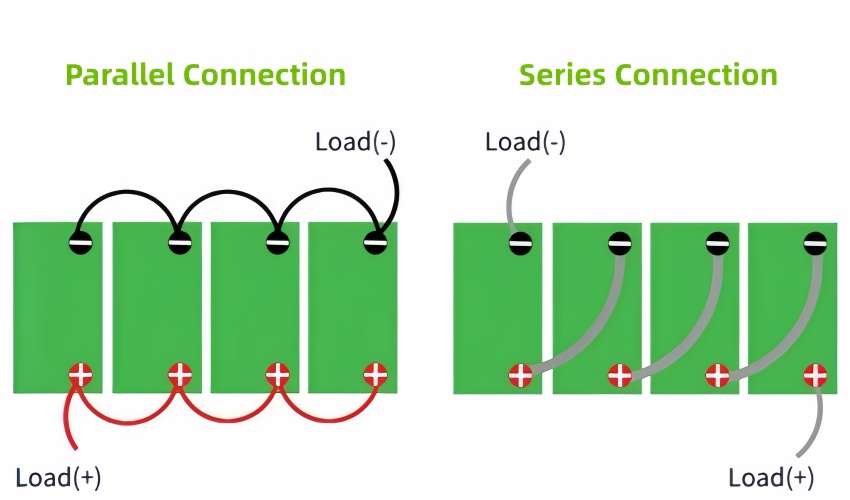
Think of it like a chain—hook the positive of the first battery to the negative of the next, and keep going until the whole bank is connected.
Measure the total voltage – check between the negative terminal of the first battery and the positive terminal of the last battery. That’s the voltage your system will use.
Connect to your equipment – make sure your device matches this voltage before powering it up.
Think of it this way: two 12V 100Ah batteries in series give you 24 volts and 100Ah—2,400Wh of energy. Add a third, and the voltage goes up to 36V, but the total capacity stays the same.
In a parallel setup, the voltage doesn’t move—but you get more runtime. That’s why people use it in RVs, marine boats, and backup systems where keeping things running matters more than higher voltage.
Here’s a simple way to get them connected.
Join all positive terminals together – connect the positive terminal of each battery to the next.
Join all negative terminals together – do the same for the negative side.
Check the voltage and connect – measure across any positive and negative terminal; the voltage stays the same as a single battery.
Say you hook up two 12V 100Ah batteries in parallel—you get 12 volts at 200Ah, which doubles how long they last. Add a third, and the voltage stays the same, but the capacity climbs to 300Ah for even more runtime.

In most cases, the answer is no.
Lithium batteries and lead-acid batteries behave very differently, especially during charging and discharging.
They differ in:
Voltage curves
Internal resistance
State-of-charge (SOC) behavior
Because of these differences, connecting them directly in parallel can cause uneven current sharing. One battery may end up doing most of the work, leading to excess heat, faster aging, and unstable system performance.
Related reading: Lead Acid Battery vs Lithium Ion for Forklifts
When is a parallel connection possible?
A parallel setup can work—but only if the lithium battery is made for it.
In these models, the BMS(Battery Management System) controls how much current can flow in and out, which helps to:
Prevent surge currents
Reduce the imbalance between battery types
Keep the system stable
Polinovel lithium batteries with this design have been tested in parallel with lead-acid batteries under controlled, real-world conditions.
If you’re interested, you can watch our test through this link—Polinovel Lithium Battery and Lead Acid Parallel Connection Test
Before you try this setup
Only consider a mixed parallel system if all of the following are true:
The lithium battery explicitly supports parallel use with lead-acid
Both batteries operate at the same system voltage
Charging parameters are properly managed
The setup has been tested or approved by the battery manufacturer
If you’re unsure, don’t guess. In real use, mixed battery systems rarely act the way you expect from specs alone. The safest move is to confirm with the manufacturer before trying the setup.
To determine the optimal wiring approach, consider the following guidance.
1. Series wiring – for higher voltage needs
Perfect if you’re powering high-voltage equipment like large inverters or industrial machines.
Higher voltage means lower current, which reduces heat and lets smaller wires do the job.
2. Parallel wiring – for longer runtime
Ideal for RVs, boats, or backup systems where you want devices to run longer without changing voltage.
Adding batteries increases capacity, so your lights or solar system can keep running for hours or days.
Watch out: parallel banks push higher total current. Weak or old batteries can discharge unevenly, shortening their lifespan, and you’ll need thicker cables.
Quick guide:
High-voltage, power-hungry device? → Series
Long runtime, standard voltage? → Parallel
By now, the difference between series and parallel wiring should be clear.
Series increases voltage, while a parallel extends the runtime. The concept is simple—but choosing the right one still takes some thought.
What really matters is how your system uses power in real life. Start with your device’s voltage requirements, then decide whether you need more power or longer runtime. When your wiring matches your load, everything runs more smoothly and safely.
Related reading: Which Lithium Ion Battery Types Work Best for You?
If you’re still unsure which setup makes the most sense, that’s completely normal. Many systems look fine on paper but behave differently once they’re running. You’re not alone. Polinovel helps you choose a safe and efficient battery configuration for your RV, solar system, or backup power setup. Get in touch with our experts and make sure your batteries work reliably and last longer.