

close
Choose Your Site
Global
Social Media


LiFePO₄ Battery Voltage Chart: State of Charge Explained shows how voltage connects to battery SOC. If you use a LiFePO₄ battery, understanding this chart helps you read energy levels clearly. This guide covers voltage behavior, SOC basics, and how to monitor performance. It helps you avoid common mistakes and manage your battery better. Whether for solar or off-grid systems, you’ll get clear, practical insights.
A LiFePO₄ battery voltage chart is a reference tool. It maps voltage levels to the battery’s state of charge (SOC). In simple terms, it helps you estimate how much energy remains inside the battery. Each voltage point corresponds to a specific SOC percentage. When the voltage is high, the battery is closer to full. When it drops, energy is being used. It’s a quick way to “read” the battery’s condition without complex tools.
Here’s how it works:
| Voltage (per cell) | Approx. SOC (%) | Battery Status |
|---|---|---|
| 3.65V | 100% | Fully charged |
| 3.40V | 90% | Nearly full |
| 3.30V | 70–80% | Moderate charge |
| 3.20V | 50% | Half charged |
| 3.10V | 20–30% | Low charge |
| 2.80V | 0–10% | Near empty |
Voltage charts matter for battery management. They guide charging decisions. They help prevent overcharging or deep discharging. It protects battery life and performance. They are also useful for system design. Engineers use them to size batteries. Installers use them to monitor energy systems. You can too, even without technical background.
LiFePO₄ batteries behave differently from other battery types. Their voltage curve is very flat.
Most of the time, voltage stays almost the same during discharge. It doesn’t drop quickly. This makes SOC estimation a bit tricky.
Voltage stays near 3.2V for a long period
Small voltage shifts = large energy changes
It can look “full” even when half used
Because of this, it’s important to use a proper chart. Guessing based on voltage alone may lead to errors.
Lead-acid batteries behave differently. Their voltage drops steadily as they discharge. That makes them easier to read.
| Feature | LiFePO₄ Battery | Lead-Acid Battery |
|---|---|---|
| Voltage curve | Flat | Steep |
| SOC accuracy | Needs careful reading | Easier to estimate |
| Discharge behavior | Stable | Gradual decline |
| Voltage sensitivity | Low | High |
So, LiFePO₄ needs more precise monitoring tools. Voltage charts help bridge that gap.
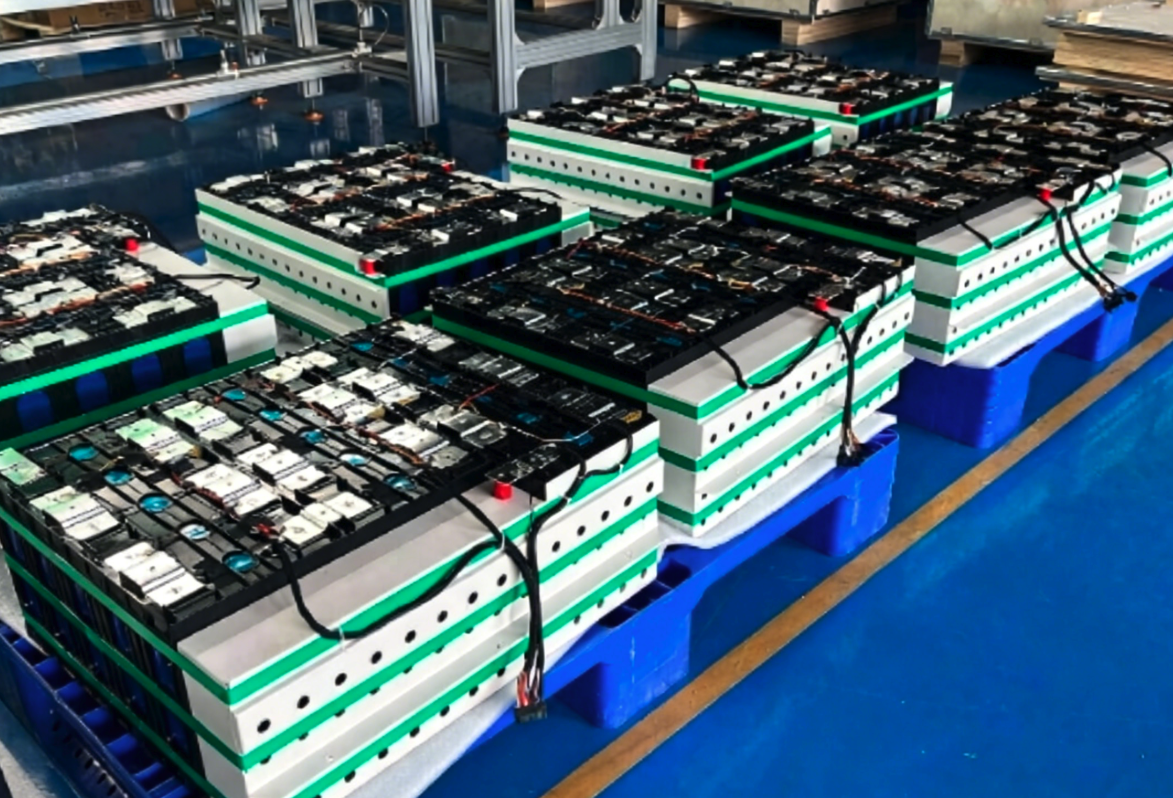
SOC stands for State of Charge. It tells you how much energy remains inside a battery at a given time.
In simple terms, it’s like a fuel gauge for your battery.
100% SOC means fully charged
50% SOC means half energy left
0% SOC means empty
SOC connects directly to usable energy. When SOC is high, more power is available. When it drops, energy supply decreases.
You can think of it this way:
| SOC (%) | Energy Level | Practical Meaning |
|---|---|---|
| 100% | Full | Maximum usable energy |
| 75% | High | Strong performance |
| 50% | Medium | Balanced usage |
| 25% | Low | Limited power available |
| 0–10% | Critical | Recharge needed soon |
So SOC helps you understand how much energy you can still use before charging again.
There are several ways to estimate SOC. Each method has its own role. Often, they work together.
This method uses battery voltage to estimate SOC.
Measure voltage
Compare it to a reference chart
Estimate charge level
It’s simple. But not always precise. LiFePO₄ voltage stays stable. So small changes may be misleading.
A Battery Management System (BMS) is a smart control unit.
Tracks voltage, current, and temperature
Monitors charge cycles
Estimates SOC more accurately
It collects data in real time. Then it calculates SOC using internal algorithms.
This method measures energy flow in and out of the battery.
Counts how much energy is used
Tracks how much is added during charging
Calculates SOC based on usage
Here’s a quick comparison:
| Method | Accuracy | Complexity | Key Benefit |
|---|---|---|---|
| Voltage | Low | Simple | Quick estimation |
| BMS | High | Advanced | Real-time monitoring |
| Amp-hour (Ah) | Medium | Moderate | Tracks energy flow |
Using more than one method improves accuracy. It reduces errors.
Charging "Illusions": Surface Charge & Hysteresis Have you ever seen your battery hit 14.4V (for a 12V system) while charging, only to watch it drop to 13.3V the moment you unplug it? This isn't a malfunction; it’s the Hysteresis Effect. Surface Charge: During charging, chemical activity creates a "fake" high voltage on the surface of the plates. The Settling Period: To find the True Resting Voltage, you must let the battery "rest" with no load or charger for 30–60 minutes. Pro Tip: Only compare your voltage to an SOC chart after this settling period. If you measure while charging, the chart will always suggest the battery is fuller than it actually is.
A flat discharge curve means voltage stays nearly constant during most of the battery’s use. It doesn’t drop in a straight line like other battery types.
For LiFePO₄ batteries, this is very normal.
Voltage holds steady for a long time
SOC drops while voltage looks unchanged
The battery feels “stable” during use
This happens mainly between 80% and 20% SOC. During this range, voltage barely moves.
Internal chemistry stays consistent
Energy release is smooth
Voltage output remains close to 3.2V per cell
So you might see:
| SOC Range | Voltage Behavior | What It Feels Like |
|---|---|---|
| 100–80% | Slight drop | Quick early change |
| 80–20% | Very stable | Long plateau |
| 20–0% | Fast drop | Energy drains quickly |
This is why voltage alone can be misleading. It looks stable, but energy is still being used.
The voltage curve can be divided into three clear zones. Each zone behaves differently.
Voltage starts high
Drops quickly at the beginning
Moves from about 3.65V down to ~3.4V
This zone shows a rapid voltage drop. Small usage leads to noticeable voltage change.
Voltage stays nearly flat
Covers most of the capacity
Around 3.30V to 3.25V
This is the most stable part. It holds energy for a long time.
Voltage drops faster again
Happens below ~20% SOC
Falls toward 2.8V
Energy depletes quickly here. It signals the need to recharge soon.
Here’s a simple breakdown:
| Zone | Voltage Range | Behavior | SOC Impact |
|---|---|---|---|
| High | 3.65V → 3.40V | Fast drop | Early usage |
| Mid | 3.40V → 3.20V | Flat plateau | Bulk of capacity |
| Low | 3.20V → 2.80V | Rapid drop | End of discharge |
Each zone tells a different story. Together, they show the full picture.
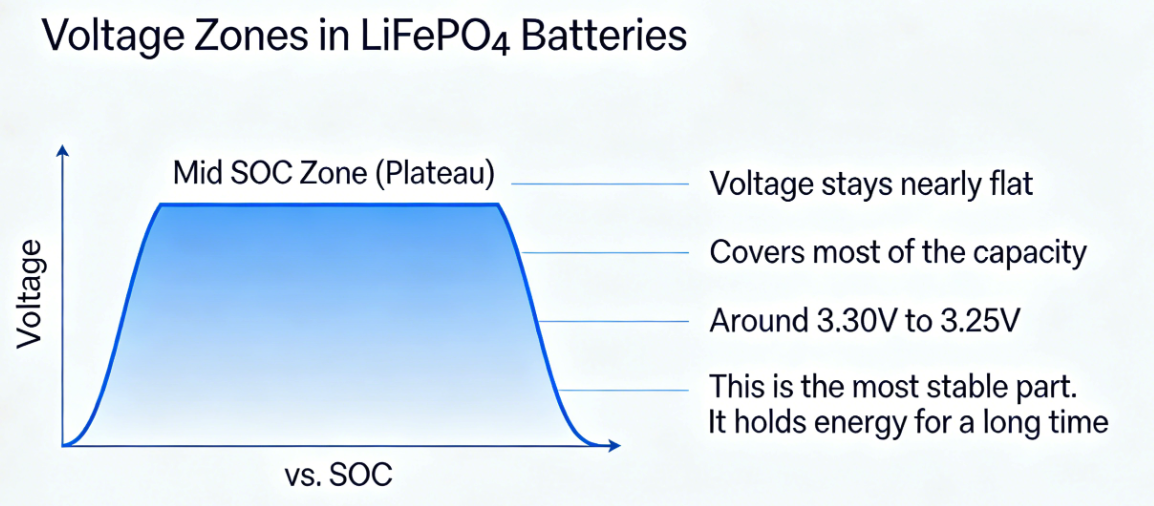
Voltage changes depending on conditions. It’s not always the same.
This is the voltage when the battery is idle.
No load connected
No charging or discharging
Stable and accurate reading
It reflects true battery condition.
This is the voltage while the battery is powering a device. It is often called voltage under load, and it behaves differently from resting voltage in a LiFePO₄ battery system. The voltage drops temporarily when the battery supplies current. It depends directly on the current draw from the connected load. Higher power demand leads to a more noticeable voltage decrease, so the reading becomes lower than the resting voltage.
Why does this happen? The main reason is internal resistance inside the battery. When current flows, it creates a small voltage drop across this resistance. As a result, higher load conditions cause a larger voltage drop. More energy flows out quickly, and the battery responds with a temporary dip in voltage. Once the load is removed, the voltage can recover and rise again toward its resting level.
When the load is removed:
Voltage rises back up
It stabilizes again
It may not fully return to original level
This recovery helps estimate real SOC.
| Condition | Voltage Level | Behavior |
|---|---|---|
| Resting | Higher | Stable, accurate |
| Under load | Lower | Temporary drop |
| After load off | Recovers | Partial rebound |
So when reading voltage, timing matters. It affects accuracy. We need to observe both conditions to understand battery performance better.
Now you understand how the LiFePO₄ battery voltage chart reflects state of charge and why voltage alone is not enough. With better monitoring, you can protect your battery and improve performance. For reliable LiFePO₄ battery solutions, Polinovel offers high-quality products designed for long life and stable energy storage.
A: Ideal voltage depends on SOC. Around 3.2V per cell is typical nominal. Full charge reaches about 3.6–3.65V per cell.
A: It is not always recommended. Occasional full charge is fine, but regular 100% charging may reduce lifespan.
A: About 2.8V per cell is near empty. Going lower risks battery damage and should be avoided.
A: Check regularly during use. Monitoring is more important under load or before charging cycles.
A: Keep above 20% SOC or around 3.0V per cell to protect battery life.